Niyogi Committee Report (PART 2):
‘Conversion muddles the convert’s sense of unity and solidarity with his society, country’
‘Conversion muddles the convert’s sense of unity and solidarity with his society, country’
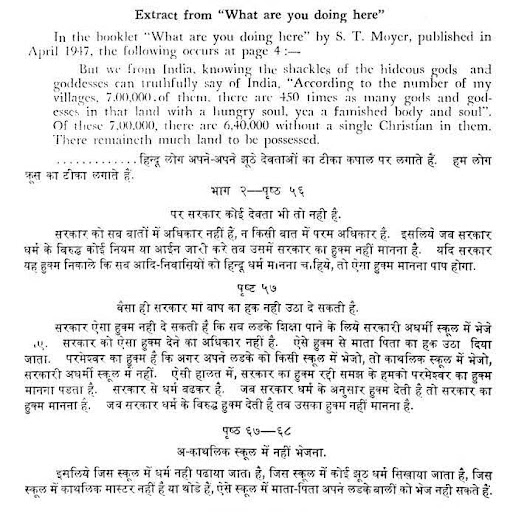
Besides conducting a thorough enquiry into the activities of Christian missionaries, especially the foreign missionaries, the Niyogi Committee or the ‘Christian Missionary Activities Enquiry Committee, Madhya Pradesh’, recorded vast evidence of such activities. Based on the evidence, it arrived at the conclusion: “As conversion muddles the convert’s sense of unity and solidarity with his society, there is a danger of his loyalty to his country and State being undermined.” In view of this threat, the committee made certain recommendations. This led to several States enacting laws against religious conversions by force. However, much still needs to be done as far as the influence that the missionaries wield through the schools, hospitals, and orphanages operated by them is concerned. The rise of aggressive Islamic conversion machinery has only compounded the problems in India. As stated in the earlier part of this series, the Niyogi Committee shed light on how the ‘system’ operated back then to arouse separatist sentiments, especially among the tribals. Several observations of the committee merit attention of the lawmakers because they are relevant even today. The committee did not mince words while reflecting the gravity of the situation observing: “While the Census officer isolates certain sections of the people from the main bodies, the Missionaries by converting them give them a separate nationality so that they may demand a separate State for themselves.”
This observation makes one suspect whether such elements are still operating from the shadows in present-day India. This suspicion deepens when one reads or hears the ‘appeals’ to certain sections of the society to register themselves as ‘separate religions’ in the Census. Is it a precursor to claiming ‘separate nationality’ and consequent secession from India in future? Well, every Indian needs to be watchful in this regard during the upcoming Census of India.
Committee’s Observations
· The committee report records one more incident that may come as a shocker to many today: “Rev. J. Lakra was suspected of dissuading Christians from participating in Mahatma Gandhi’s ashes immersion ceremony observed at Jashpur on 12th February 1948.”
· As Missionary activities spread in Surguja district, local non-Christians got alarmed. In 1952, leading citizens of the district including the Maharaja of Surguja distributed pamphlets and addressed gatherings advising the Adivasis not to give up their religion for the sake of monetary benefits or temptations. Members of the Rashtriya Swayam Sewak Sangh and the Arya Samaj joined hands and intensified propaganda against Missionary activities.
· The report lists various incidents of missionaries singing ‘provocative songs denouncing Hindu religion’, ‘smuggling rice to Bihar in contravention of Government orders’, issuing threats of violence against tribals who opposed conversion to Christianity, using ‘threats and intimidation’ against local Uraon tribals, missionaries lodging ‘false and frivolous’ complaints against the Government servants etc – in many cases, even the offences were registered.
· 13 villagers of village Dhajji and Sukhari, Police Station Samri, complained against Patras Kerketta of the Roman Catholic Mission along with other missionaries who addressed a meeting in the village stating that the Congress Raj was bad because it was giving trouble to the Christian people; that Christians were getting a Raj in which people would get all facilities… He asked them to unite together against the Government and threatened that those who did not co-operate would be turned out of the villages ‘when Christians got Jharkhand’.
· Two babies were converted to Christianity when their grandmother had taken them to a hospital to get medicines for eye trouble… Later, “as per the wishes of the villagers, the babies were reconverted to Hindu religion and Patras Kerketta tendered an apology to the Additional District Magistrate”.
All these incidents expose the coercive and deceptive ways and means adopted by the Christian missionaries to convert innocent people. Moreover, they bring to the fore the vitally important fact that the tribals of the area considered themselves to be a part of Hindu religion. They did not consider themselves as a separate entity as is being projected by some so-called divisive elements today.
The observation of the Niyogi Committee, “The intensified activity of the Christian Missions in India is an integral part of the post-war Christian world policy” was not relevant in only that particular time-period. One can see the same policy and activity playing out in present-day India in one way or the other. Only the influence cannot get reflected in numbers today.
Missionaries’ Responses
The churches and Christian missionaries submitted their responses to the questionnaire of the Niyogi Committee. A look at some portions of these responses provides some valuable insight on the thinking, and methods of operations of the missionaries, and how they tried to whitewash the excesses by using deceptive expressions. Let’s take a look at three representative responses in brief.
· Lutheran Church response – The Lutheran Church entered Surguja in 1951. The total number of converts up to date was 2,033 (at the time of hearing before the committee). The people are converted both individually and in groups. In the case of a family usually the whole family is baptized if the parents are willing. The grown-ups are not baptized, if they are not willing… Change of religion implies enrichment of culture… Education is not complete without religious instruction.
· Chairman and Secretary of the General Conference, Mennonite Mission in India, Saraipali, Raipur district – As Christians we do not recognize caste. Missionaries must sign a pledge to keep out of politics. Some social customs are kept when they are not contrary to the Christian faith. (However, as the committee found during enquiry, the missionaries did not keep out of politics.)
· Rev. Canon R. A. Kurian, The Gondwana Mission (Nagpur Diocese), Nagpur – Indian missionaries and Pracharaks (new converts were roped in as Pracharaks on Rs. 40 per month) have a right to make references to the Central or State Governments in India, subject to law and order. Foreign missionaries have no right to make adverse remarks about an Indian Government, in political matters… At the moment, we encourage our people to give all their support to the Congress party because that party has a leader in Pandit Nehru who has shown himself to have risen above narrowness and fanaticism, and treats members of all religions alike… I cannot think of missionaries destroying or desecrating non-Christian places of worship or burial grounds. The Bible condemns acts of sacrilege. If, however, the whole village becomes Christian, they themselves will either destroy or abandon their temples… Before becoming a Christian, one has to give up his ancestral religion, whatever it was; he cannot continue his old practices, such as worship of Gram Devtas, but there is no objection to his copying old ancestral customs in ancient marriage rites, provided there is no compromise on religious grounds. … There is such a thing as principles of comity. It is not right for one mission to encroach into the area of another. But still there are some who have no principles in this respect. They deserve to be sent back to their countries… Religious teaching should be allowed in schools, subject to the condition that a child is not forced to attend religious instruction of a particular religion, if he or his parents have objection to it. Also, a school run by an agency belonging to one particular religion, should not be forced by the Government to provide for the teaching of other religions in their institutions…
The Impact
After extensive enquiry and field visits, the Niyogi Committee arrived at the conclusion that schools, hospitals, and orphanages were used by the Christian missionaries for proselytization. The committee’s findings revealed that in some places the missions used to serve ‘extra religious ends’. In dire contravention of assurances given by foreign and national Missionaries to the authorities, instances of indirect involvement in political activities were brought to the notice of the committee. One particular observation of the committee that remains significant and relevant even today is: “As conversion muddles the convert’s sense of unity and solidarity with his society, there is a danger of his loyalty to his country and State being undermined. A vile propaganda against the religion of the majority community is being systematically and deliberately carried on so as to create an apprehension of breach of public peace.”
The major recommendations of the committee included absolute prohibition of any attempt at proselytization ‘by force or fraud, or threats or illicit means or grants of financial or other aid, or by fraudulent means or promises, or by moral and material assistance, or by taking advantage of any person’s inexperience or confidence, or by exploiting any person’s necessity, spiritual (mental) weakness or thoughtlessness’. The committee also recommended ‘suitable control on conversions brought about through illegal means’ and ‘legislative measures to be enacted, if necessary’.
Other recommendations included constitution of Advisory Boards at the state, regional and district levels, amendment to rules relating to the registration of doctors, nurses and other personnel employed in hospitals ‘to provide a condition against evangelistic activities during professional services’.
A major impact of the committee’s findings and recommendations was enactment of laws against conversions by force, fraud, or inducements. Over the years, several States have enacted the ‘Freedom of Religion’ laws. These include Odisha law (1967), Madhya Pradesh (1968), Arunachal Pradesh (1978), Chhattisgarh (2000 and 2006), Gujarat (2003), Himachal Pradesh (2006 and 2019), Jharkhand (2017), Uttarakhand (2018). Himachal Pradesh (2019) and Uttarakhand laws, which declare a marriage to be void if solemnised for the sole purpose of unlawful conversion, or vice-versa. Tamil Nadu (2002) and Rajasthan (2006 and 2008) also passed similar legislative resolutions. However, buckling under the pressure exerted by Christians through protests, Tamil Nadu repealed the law in 2006. As for Rajasthan, the legislative resolution did not receive the assent of the Governor and President respectively. In 2020, following a spate of forced/fraudulent religious conversions, Uttar Pradesh government promulgated an Ordinance. Madhya Pradesh government also promulgated an Ordinance in January 2021 to regulate religious conversions in the light of new developments.
Introductory Memo