Niyogi Committee Report (Part 1 ):
How Niyogi Committee exposed Christian missionaries’ support for ‘Adiwasisthan’ plot
How Niyogi Committee exposed Christian missionaries’ support for ‘Adiwasisthan’ plot
The National Council of Churches in India (NCCI) has filed a petition before the Supreme Court challenging the Constitutional validity of the anti-conversion laws enacted by 12 States. Earlier, in December 2025, on a petition filed by the Catholic Bishops’ Conference of India challenging the anti-conversion law in Rajasthan, the Apex Court had issued notice. These developments have brought back in public discourse the issue of conversion to Christianity. However, what necessitated promulgation of the anti-conversion laws in India is rarely discussed. This is the first of the two-part series to lay emphasis on the crucial Niyogi Committee report, which explains the historical roots of these laws in post-Independence India.
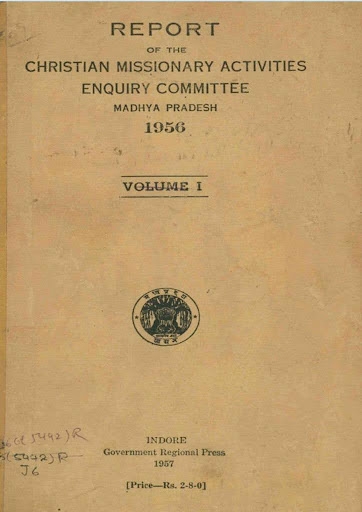
As a nation moves forward in time, its collective memory tends to forget some important chapters from history. Niyogi Committee, officially named ‘Christian Missionary Activities Enquiry Committee, Madhya Pradesh’, is such a ‘forgotten’ chapter. Today, not many are aware of the key role played by this committee in protecting the integrity of India from the challenges the country faced soon after it attained independence and was overcoming the deep wounds of the partition. The committee exposed the Christian missionaries provoking tribals of India to severe ties with their Bharatiya civilisational roots, brought to light their plan for creating ‘Adiwasisthan’ on the lines of Pakistan, and made recommendations leading to anti-conversion laws that checked religious conversions by the Christian missionaries. Disseminating information about Niyogi Committee, its landmark report, recommendations, and to carry forward that awareness to foil isolationist agendas of Left-Liberals comprising Christian elements is essential even in the present day context as the efforts of alienating tribals from mainstream Bharatiya civilization are still on.
The Constitution of India provides for the right to propagate one’s religion. However, all the rights are subject to maintenance of public order. For that matter, the Constitution imposes ‘reasonable restrictions’ and does not offer any freedom as ‘absolute’. The proponents of religious conversion interpret the Constitutional provision of right to propagate one’s religion as implying that there is a right to convert people. Though convenient to them, this interpretation need not be accurate and correct.
However, the intent of Christian Missions and preachers to convert the people of India was exposed soon after India attained Independence from the British Raj. In 1956, the erstwhile Government of Madhya Pradesh appointed the Niyogi Committee. It marked the first major government investigation into Christian missionary activities in India, responding to complaints about alleged forced conversions and fears of ‘creating a State within a State’. The report recommended curbing missionary proselytization, prohibiting conversions by inducement or medical care, and checking foreign missionary influence. This led to public debates over the strategies adopted by the Christian missionaries to convert Indians, particularly the tribals, and influenced early anti-conversion laws in several States. The Catholic and Protestant missions both faced State scrutiny in tribal and rural areas, as the government was concerned that missionaries were alienating converts from their national identity.
The Committee
Dr. M. Bhawani Shankar Niyogi, former Chairman of Public Service Commission, Madhya Pradesh, and retired Chief Justice of the High Court at Nagpur, was appointed as Chairman of the committee. Ghanshyam Singh Gupta, former Speaker of Madhya Pradesh Legislative Assembly; Seth Govind Das, Member of Parliament, Jabalpur; Kirtimant Rao, MLA from Aheri in erstwhile Chanda district (now Aheri is in Gadchiroli district); Prof. S. K. George from Commerce College, Wardha; and B. P. Pathak, Secretary to the Madhya Pradesh Government, were the members. As Seth Govind Das resigned from the committee on 8th May 1954 due to his pre-occupation with other work, he was replaced by Ratanlal Malviya, Member of Parliament, Manendragarh. On his appointment to the Madhya Pradesh Cabinet, Kirtimant Rao also resigned and was succeeded by Bhanupratapsingh Giri Raj Singh Deo, Member of Parliament, Komakhan, in Mahasamund tehsil of erstwhile Raipur district (now in Chhattisgarh).
Officially named ‘Christian Missionary Activities Enquiry Committee, Madhya Pradesh’, it submitted its report to the government on 18th April 1956. Dr. M. B. Niyogi, M.A., LL.M., LL.D. (Hon.), Kt., C.I.E., who was Chairman of the Enquiry Committee, submitted the report to K. B. L. Seth, I.C.S., Chief Secretary to Government of Madhya Pradesh, Nagpur. During the course of enquiry, the committee extensively toured various parts of the country from 5th June 1954 to 25th November 1955.
The committee visited Raigarh, Dharmjaigarh, Pathalgaon, Ludeg, Jashpurnagar, Ara, Gholang, Ginabahar, Muskutri, Ambikapur, Kusmi, Balrampur, Dhorpur, Sitapur, Raipur, Dhamtari, Mahasamund, Bagbahera, Pithora, Basna, Jagdishpur, Simga and Bisrampur, Bilaspur, Takhatpur, Jarhagaon, Mungeli, Chandkhuri (Baitalpur), Pendra Road, Champa, Korba, Amravati, Achalpur, Chikhaldara, Dharni, Dedtalai, Kanapur, Burhanpur, Khandwa, Pandhana, Aolia, Koladit, Balahi-Awar, Khedi, Sirpur, Harsud, Karpur, Piplod, Bhusawal, Yavatmal, Harjuna, Ralegaon, Ner, Runza, Umri, Pandharkawda, Botoni, Rajur, Wani, Kamathwada, Darwha, Digras, Pusad, Umarkhed, Washim, Akola, Mehkar, Chikhli, Buldhana, Malkapur, Mandla, Barela, Jabalpur, Khamaria, Kundam, Panagar, Schora, Katni, Dindori, Betul, Amla, Chicholi, Padhar, Nimpani, Shahapur, Chhindwara, Seoni, Balaghat, Baihar, Garhi, Raipur, Sagar, Khamgaon etc and held meetings with tribals, representatives of Christian and non-Christian organisations. The committee also visited various Christian missions at multiple locations. In all, as per the committee’s records, it visited 77 locations and interacted with 11,360 people who had come from 700 villages to appear before the committee.
The questionnaire circulated by the committee evoked 375 replies, out of which 55 were from Christian individuals or organisations and 330 from non-Christians.
Missionaries, ‘Adiwasisthan’ Plot, ‘Red Corridor’
The committee’s enquiry revealed the most shocking aspect of the Christian missionaries’ activities – how they were linked to the ‘Adiwasisthan’ plot! The reports which the Government of Madhya Pradesh had obtained from the former province in respect of the activities of missionaries showed that their role in the past ‘had not been healthy, their methods not savoury’.
Two or three times there had been rebellions in the province as well as the princely states in it; and even the erstwhile Political Department, which was in the hands of the European Christians, was compelled to put restrictions on the entry of Missionaries, and their movement in the former (pre-Independence) princely states. The Niyogi Committee also mentioned the Acts passed by the former Princely States of Surguja, Udaipur and Raigarh regulating conversion and restricting the movement, etc., of Missionaries. At one place, the committee observed, “On the integration of the States, missionaries became afraid of losing their influence. So, they started an agitation, playing on the religious feelings of the primitive Christian converts, representing the Madhya Pradesh Government as consisting of infidels and so on. Some of the articles published in Missionary papers, such as ‘Nishkalank’, ‘Adiwasi’, and ‘Jharkhand’ were hardly distinguishable from the writings in Muslim papers advocating Pakistan before the 15th of August 1947. The Missionaries launched a special attack on the opening of schools by the Madhya Pradesh Government under the Backward Area Welfare Scheme.”
In the Merged States of Surguja and Udaipur during the months following their Integration, Rev. Stanislaus Tigga, a Roman Catholic priest with his headquarters in Ranchi, kept on visiting these areas ‘surreptitiously’ and ‘carried on propaganda in the garb of religion’. The strip of land comprising Surguja, Korea, Jashpur, Udaipur, Changbhakar and some other small States of Orissa (now Odisha) is surrounded by Bihar and Orissa States and is inhabited by a very large percentage of tribals. The tract is full of forests and mineral resources. Foreign missionaries from Belgium and Germany had established themselves in Bihar and Orissa and also in Jashpur in 1834 and had succeeded in converting a very large number of people to Christianity. “To consolidate and enhance their prestige, and possibly to afford scope for alien interests in this tract, the Missionaries were reported to be carrying on propaganda for the isolation of the Aboriginals (as the term was used back then) from other sections of the community”, stated the report. The missionaries brought together local Christians, Muslims, and influenced local tribals to launch this movement but carefully excluded all the nationalist elements.
The observation regarding the missionaries’ links to ‘Adiwasisthan’ in the Niyogi Committee’s enquiry report should shock every Indian even today. “The demand for Adiwasisthan was accentuated along with the one for Pakistan in 1938. The Muslim League is reported to have donated Rs. 1 lakh for propaganda work. With the advent of political independence in India, the agitation for Adiwasisthan was intensified, with a view to forming a sort of corridor joining East Bengal with Hyderabad, which could be used for a pincer movement against India in the event of a war between India and Pakistan,” stated the report. If this revelation is processed with the post-Independence scenario, it gives another shock. For, this is the same belt that is rich in forest and minerals, which also came to be known as ‘Red Corridor’ dominated by the Naxalite/Maoist terrorists for decades. Naturally, this raises suspicion, along with the fact that several Liberation Theologist Christians were involved, whether the missions were associated with the Left Wing Extremism in these areas, choking exploration of mineral wealth and thus blocking India’s economic development.
The Christian community, ‘supported’ by the Missionaries of the Ranchi district, organised themselves into a ‘Raiyat Warg’, ostensibly to do social work, but in reality to propagate the Adiwasi separatist movement. Commenting on the ‘divisive doctrine of this organisation of the Christians’, the Niyogi Committee stated, “The separatist tendency that has gripped the mind of the aboriginals under the influence of the Lutheran and Roman Catholic Missions is entirely due to the consistent policy pursued by the British Government and the Missionaries. The final segregation of the aborigines in the Census of 1931 from the main body of the Hindus considered along with the recommendations of the Simon Commission which were incorporated in the Government of India Act, 1935, apparently set the stage for the demand of a separate State of Jharkhand on the lines of Pakistan.” It is a different story that after Independence, Jharkhand was formed as an Indian state from the point of view that smaller States are easy to govern. But the missionaries back then had tried to convert the demand for Jharkhand into a ‘separatist tendency’. Thanks to the maturity of tribals and their attachment to Indian civilisational roots, they did not fall prey to the missionaries’ instigation.
The first session of the Adiwasi Sabha Conference on 22nd January 1939 at Ranchi, which was presided over by Shri Jaipalsingh, Madhya Pradesh. In his address he said: “All the Missionary institutions working here are with us… Even the Bengalis are crying for separation, the Europeans and Anglo-Indians are openly showing us their sympathy”. This separatist sentiment initiated by the Christian section thereof “ is a feature which is common to the developments in Burma, Assam and Indo-China among the Karens, Nagas and Amboynes. This is attributed to the spirit of religious nationalism awakened among the converted Christians as among the followers of other religions. But the idea of change of religion as bringing about change of nationality appears to have originated in the Missionary circles,” the committee noted.
Introductory Memo