Padma Shri: Beyond The Spotlight
RVS Mani: Embodiment of dedication to truth, national security
RVS Mani: Embodiment of dedication to truth, national security
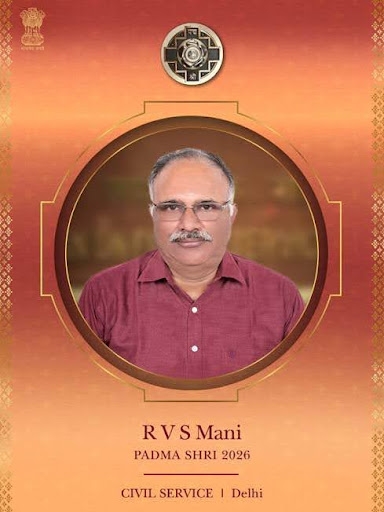
When a boat is caught in a storm, what helps a sailor is his courage of conviction. Similarly, in life, a person with conviction only can weather the toughest of challenges. Ramaswamy Venkata Subra Mani, popularly known as RVS Mani, is one such person. No Indian, no Hindu, can ever forget RVS Mani’s contribution to national security because he foiled the sinister plot to fabricate ‘Saffron Terror’. A distinguished former bureaucrat, to whom the Government of India has announced Padma Shri, RVS Mani is a man with unwavering commitment to truth amid political pressure and threats to life. RVS Mani was born in Delhi into a family with a legacy of public service as his father also had served in the Ministry of Home Affairs. As far as academic qualification is concerned, RVS Mani completed LL.B. from Delhi University, M.A. in Sociology and M.Sc. in Human Resource Development from the University of Manchester (UK), and further specialised as a Fellow in Arbitration from the Singapore Institute of Arbitration. The celebrated civil servant of India also did PG Diplomas in Alternative Dispute Resolution. All through his education and career, while discharging the responsibilities with full commitment, he stayed true to the Bharatiya roots. He is fluent in Sanskrit and well-versed in Vedic texts, and Bhagavad Geeta. In his own admission, he refers to Bhagavad Geeta whenever he faces any trouble in life. He does so because he follows his father’s advice. These attributes of his personality speak a lot about his Sanskars.
RVS Mani began his career as a civil servant by joining the Central Secretariat Service (CSS). Gradually, he rose to key roles. He shot to fame as an Under Secretary in the Internal Security Division of the Ministry of Home Affairs from 2006 to 2010. In this position, as he has mentioned in his books and interviews, he had access to sensitive dossiers, coordinated with the Intelligence agencies, processed counter-terrorism alerts, and also liaised with law enforcement agencies. He also served as Deputy Secretary in the Ministry of Textiles (Finance) handling infrastructure for textile clusters like Gujarat Eco Park and rehabilitation for affected units in Tirupur and Rajasthan, in North East development planning, and in international cooperation on conventions and intellectual property. However, he is best remembered as the fearless Under Secretary in the Internal Security Division of the Ministry of Home Affairs. Why? Let’s know more.
Ishrat Jahan Case Whistleblowing
Prior to the 26/11 case, Mani gained prominence in the Ishrat Jahan encounter case in Mumbra in 2004. Four terrorists including Ishrat Jahan were killed in an encounter by Gujarat Police and other agencies, following a tip-off. However, some elements had already started working to lay the foundation for hatching the conspiracy of ‘Hindu Terror’. So, they called the encounter ‘fake’ and effort was made to politically target Narendra Modi, who was then Chief Minister of Gujarat, and Amit Shah, the then Home Minister of Gujarat. Mani first shot to limelight during this case. As Under Secretary in the Internal Security Division in the Ministry of Home Affairs, he filed an initial affidavit affirming Ishrat Jahan’s links with Pakistan-based terrorist organisation Lashkar-e-Taiba. He cited Intelligence inputs. However, such was the power wielded by the shadowy elements in the Congress-led government in the Centre that he was ‘coerced’ to file a revised affidavit to dilute the claims made earlier. Tremendous pressure was mounted on him to frame Narendra Modi and Amit Shah in the case somehow, but he refused to sign the papers that were not based on facts. Despite harassment, he stayed firm on the side of truth. His stand exposed political meddling in security matters, earning him the stature of a whistleblower. The truth remained truth, and Ishrat Jahan and others remained terrorists killed in a successful operation of the Intelligence Bureau. The conspiracy to demean the contributions of the Intelligence machinery and police, and seek political opportunism in a terror case was foiled.
26/11 Mumbai Terror Attack
Everyone knows about the dastardly terror attack by Pakistanis terrorists on Mumbai in the year 2008. Referred to as 26/11 terror attack, saw some celebrated police and the Indian Army officers dead. The terrorist Ajmal Kasab was caught because of the bravery of policeman Tukaram Ombale. Though the siege of the iconic Hotel Taj was brought to an end following the widely televised action by the Indian forces, the sinister conspiracy that followed aimed at branding Hindus as terrorists. The ‘Saffron Terror’ plot was hatched in the shadowy corridors of power and effort was made by certain elements in the then Congress-led Government to float the theory that Hindus were behind the attack. In fact, some of them including some IPS officers, film-makers, authors, and even some journalists had been working on this plot for quite some time to shield the exposed international Islamic terrorism.
However, RVS Mani who was stationed in the Ministry of Home Affairs control room was overseeing the real-time internal security responses and decision-making in the hours of crisis. He was deeply disturbed over the political interference leading to delayed actions such as deployment of National Security Guard (NSG), and also restrictions on CRPF and CISF. Some top bureaucrats were in Hotel Taj but had a miraculous escape. Some started making irresponsible statements to popularise the utterly false theory of ‘Saffron Terror’ to use it as a ploy to politically target the Hindu leadership and malign the Hindu community as a whole for asking pointed questions regarding the Islamists involvement in terror activities across India and the world. As Mani later mentioned in his insightful book ‘The Myth of Hindu Terror’, he felt that the 26/11 terror attack on Mumbai bore the signs of a collusion between Pakistan’s infamous agency Inter Services Intelligence or ISI and Congress party. In some of his interviews, Mani has boldly stated that the 26/11 attack was a ‘fixed match’ between ISI and Congress party.
Drawing on his experiences in the security establishment, Mani debunked the ‘Saffron Terror’ myth. He revealed how the officials were pressured, information was leaked to Pakistan, how cases like Malegaon blasts were used politically out of conspiracies to malign Hindus, and linked these to the ‘Breaking India’ forces. His shocking disclosures stunned the people as those underscored how such manipulations compromised genuine counter-terrorism efforts but prioritised political agendas over national security.
Obviously, this did not go down well with many and he was hounded. His book mentioned above offers a telling account of his ordeal and how he survived several attacks. At the same time, the book provides evidence from the official records of how Kasab and other terrorists had come from Pakistan and carried several goods manufactured in Pakistan. Of course, Mani has not shied away from exposing Pakistan for being an exporter of Islamic terrorism. He did this service to the Hindus because he felt that truth must prevail, and the evil designs must stand exposed and defeated.
The Fatwa
RVS Mani stood rock-firm on truth despite facing threats to his life. Some unsuccessful attempts were made on his life. In 2014, a ‘fatwa’ or Islamic diktat ordering ‘the faithfuls to kill’ Mani was received at his lawyer’s office. The religious fanatics issuing the ‘fatwa’ found that Mani’s actions could ‘cause danger to Islam’. The said ‘fatwa’ mentioned that RVS Mani had filed an affidavit that was crucial in determining that Ishrat Jahan was a terrorist. It also expressed displeasure over the civil servant finding Delhi Police innocent in Batla House encounter case. The ‘fatwa’ blamed Mani for filing certain reports due to which ‘many of our boys’ could not get transit remand from Gujarat jails to Delhi. The Islamic radicals issuing the ‘fatwa’ also dubbed Mani as guilty of ‘creating hurdles in the work of Islamic/Muslim organisation regarding land allotment, denotification of Waqf properties etc’. But the firm believer in the life-mantras in the Bhagavad Geeta, Mani did not get deterred. He kept doing what was right, and in favour of the truth.
Writer-Academic-Padma Shri
Post-retirement RVS Mani authored important books that criticised attempts at politicisation of the national security apparatus. His most celebrated book ‘The Myth of Hindu Terror: Insider Account of Ministry of Home Affairs 2006-2010’ was published in 2018 and was translated to Hindi, Marathi, and other languages. It exposed the manipulative forces in the erstwhile Ministry of Home Affairs. Another book ‘Deception: A Family That Deceived the Whole Nation’ published in 2021 is a fictional take on political deceit. ‘When Mani Writes’ published in 2022-23 compiles articles on internal security, politics, terrorism, and Khalistani threat. Put together, all these works reveal how anti-India forces exploited democracy, how demonetisation disrupted terror funding, and how there are patterns in the propaganda unleashed after abrogation of Article 370 relating to Jammu & Kashmir.
Apart from writing books, Mani has contributed immensely as a Visiting Professor at Sharda University, where he teaches governance, law, and internal security, drawing from first-hand insights. He has devoted his life to shaping national discourse through his writings and lectures that advocate ethical bureaucracy, transparency in Intelligence, and safeguarding security from political partisanship. He is an accomplished commentator on counter-terrorism challenges and regional threats. He has built a legacy of enriching national security thought.
Obviously, when RVS Mani’s name featured in the list of Padma Shri awardees announced on the eve of Republic Day-2026, every Indian committed to national security was elated. “Well deserved’ and ‘right choice’ were the comments on social media. RVS Mani stands as a shining example of distinguished civil service, unbiased and ethical stand in security-related matters, and remarkable literary as well as academic contributions.
May his tribe grow. Because, only the committed men with courage of conviction can ensure national security and stability.
We’re building something amazing. Congratulations to Shri RVS Mani, Retd. CSS Officer, on being conferred with the prestigious Padma Shri award in Civil Services. Honoring R. V. S. Mani @RudraVS ji, sends Padma Awards | RVS Mani from Delhi to be conferred with Padma Shri in the field of Civil Service.
Introductory Memo
🚀 Coming Soon
A proud moment for the entire CSS fraternity and a fitting recognition of exemplary public service. @CSSforum_ @RudraVS pic.twitter.com/RUMC18XBFf
a powerful message,
that integrity matters,
that truth spoken can’t be erased.
He was pressured to sign documents to fabricate the “Saffron Terror” narrative,
but he stood firm & refused to surrender his conscience,
even when the… pic.twitter.com/7RAsKViE11
For the year 2026, the President has approved conferment of 131 Padma Awards as per list below. The list comprises five Padma Vibhushan, 13 Padma Bhushan and 113 Padma Shri Awards.… pic.twitter.com/S7cPK5THgX